How Does a Marine Fire Alarm System Work on Ships? A Complete Guide
11 min read
Fire safety is one of the most important aspects of modern ship operations. Ships operate in challenging environments where fire can spread quickly through engine rooms, accommodation areas, electrical compartments, cargo spaces, and machinery rooms. Unlike buildings on land, vessels have limited escape routes and operate far away from immediate emergency assistance.
This is why a reliable marine fire alarm system is essential for protecting crew members, passengers, cargo, and valuable ship equipment.
But how does a marine fire alarm system actually work on ships? How do detectors identify fire, how does the control panel process alarm signals, and what happens after a fire is detected?
In this guide, we explain the working principles, major components, detection process, and maintenance requirements of marine fire alarm systems.
1. What Is a Marine Fire Alarm System?
A marine fire alarm system is an integrated safety system designed to detect early signs of fire, smoke, and excessive heat onboard ships and other marine vessels.
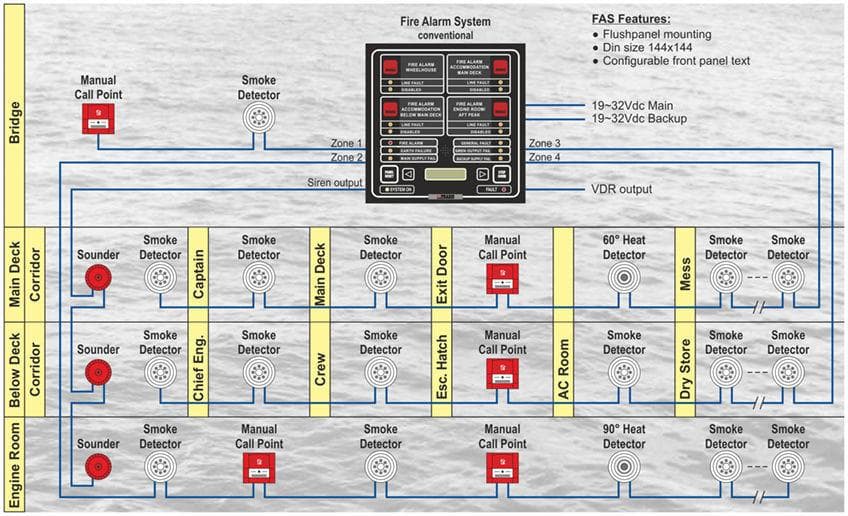
The system continuously monitors different areas of a vessel using strategically installed fire detectors. When a detector identifies conditions that indicate a potential fire, it sends an electrical signal to the Fire Alarm Control Panel (FACP).
The control panel processes the signal, identifies the affected zone or detector, and activates audible and visual alarms to alert the crew.
Depending on the vessel's configuration, the system may also communicate with other onboard safety and monitoring systems.
Marine fire alarm systems are commonly installed in:
Engine rooms and machinery spaces.
Accommodation cabins and corridors.
Bridge and navigation rooms.
Electrical and switchgear rooms.
Cargo handling areas.
Galley and kitchen spaces.
Pump rooms and technical compartments.
The primary objective is to identify fire hazards at an early stage and provide sufficient warning for the crew to take appropriate emergency action.
2. Main Components of a Marine Fire Alarm System
A marine fire alarm system consists of several interconnected components. Each component performs a specific function to ensure reliable fire detection and alarm notification.
A. Fire Alarm Control Panel (FACP)
The Fire Alarm Control Panel is the central processing unit of the entire fire detection system.
It receives signals from connected smoke detectors, heat detectors, manual call points, and other monitoring devices.
Its main functions include:
Continuously monitoring connected detection devices.
Processing incoming alarm signals.
Identifying the location of detected fire conditions.
Displaying fire alarms and fault indications.
Activating connected sounders and visual alarms.
Monitoring system communication and power supply conditions.
Modern addressable fire alarm panels can identify individual detectors, making it easier for the crew to locate the exact area where an alarm originates.
B. Smoke Detectors
Smoke detectors identify smoke particles produced during the early stages of combustion.
Optical smoke detectors generally use light-scattering technology. When smoke enters the detector chamber, smoke particles scatter light onto a sensing element, triggering an alarm when the programmed threshold is reached.
They are commonly installed in:
Accommodation areas.
Corridors and passageways.
Offices and control rooms.
Electrical equipment spaces, where suitable.
C. Heat Detectors
Heat detectors identify abnormal temperature conditions rather than smoke.
Depending on their design, they may operate when:
The surrounding temperature reaches a predefined threshold.
The temperature increases rapidly within a specified period.
Heat detectors are particularly useful in locations where smoke detectors may produce unwanted alarms due to normal operating conditions.
Typical applications include engine rooms, galleys, and machinery spaces, subject to the detector's approved operating environment.
D. Flame Detectors
Flame detectors identify the radiation emitted by flames, commonly using ultraviolet (UV), infrared (IR), or combined UV/IR sensing technologies.
They can provide rapid detection of visible flame conditions in suitable applications.
These detectors may be used in:
Fuel handling areas.
Machinery spaces.
Certain industrial and hazardous locations.
Special-purpose equipment compartments.
The correct detector technology depends on the fire risk and environmental conditions.
E. Manual Call Points
Manual call points allow crew members to activate the fire alarm manually when they discover smoke or fire.
They provide an additional layer of protection because fire detection does not depend entirely on automatic detectors.
Manual call points are installed at designated accessible locations, including escape routes and other approved positions.
F. Fire Alarm Sounders and Visual Indicators
Sounders, bells, horns, and visual alarm indicators notify crew members when a fire alarm condition occurs.
They help ensure that alarms can be recognized in different onboard environments, including noisy machinery spaces.
G. Backup Power Supply
Marine fire alarm systems require a dependable power supply.
A typical arrangement includes a primary electrical supply and an independent backup supply, such as batteries, to maintain operation when the primary source fails.
The system monitors power conditions and provides fault indications when supply problems occur.
3. How Does a Marine Fire Alarm System Work? Step-by-Step Process
A marine fire alarm system works through a continuous monitoring and response process. The following steps explain how it operates onboard a ship.
Step 1: Continuous Monitoring
Smoke detectors, heat detectors, flame detectors, and other connected devices continuously monitor their assigned areas.
Each detector is selected according to the potential fire hazards and environmental conditions of its installation location.
Step 2: Fire Detection
When smoke, excessive heat, or flame radiation is detected, the relevant detector identifies the abnormal condition.
For example:
A smoke detector identifies smoke particles.
A heat detector identifies an abnormal temperature condition.
A flame detector identifies flame radiation.
The detector then generates an alarm signal according to its operating technology and configuration.
Step 3: Signal Transmission to the Control Panel
The detector transmits its signal to the Fire Alarm Control Panel through the connected fire detection circuit or communication loop.
In conventional systems, the panel generally identifies the affected detection zone.
In addressable systems, the panel can identify the individual detector or device that generated the signal.
Step 4: Alarm Signal Processing
The control panel receives and evaluates the incoming signal.
It determines whether the signal represents a fire alarm, fault, or another monitored condition according to the system configuration.
The panel then displays the relevant information for the crew.
Step 5: Audible and Visual Alarm Activation
When a valid fire alarm condition is registered, the system activates the configured alarm notification devices.
These may include:
Fire alarm bells.
Electronic sounders.
Audible warning devices.
Flashing visual indicators.
Alarm displays on monitoring panels.
The purpose is to alert the crew and initiate the vessel's emergency response procedures.
Step 6: Crew Emergency Response
After receiving the fire alarm, the responsible crew members follow the vessel's emergency procedures.
Depending on the situation, actions may include:
Identifying the location of the fire.
Informing the bridge or designated control station.
Raising the appropriate emergency alarm.
Isolating affected machinery or electrical equipment where required.
Closing fire doors and ventilation dampers where appropriate.
Using suitable firefighting equipment.
Activating the designated fixed firefighting system when authorized and required.
The response depends on the type and location of the fire, the vessel's safety procedures, and the applicable firefighting arrangements.
4. Conventional vs Addressable Marine Fire Alarm Systems
There are two common types of fire alarm system architectures used onboard ships: conventional and addressable.
FeatureConventional SystemAddressable SystemDetection identificationIdentifies the affected zoneIdentifies individual devicesWiring arrangementSeparate detection zonesAddressable communication loopsFault identificationGenerally zone-basedMore detailed device-level informationMonitoringZone-basedIndividual device monitoringApplicationSmaller or simpler installationsComplex vessel installationsTroubleshootingRequires zone-level investigationMore precise device identification
Which System Is Better for Ships?
Addressable systems offer more detailed information about individual detectors and can simplify troubleshooting on complex vessels. However, the right solution depends on vessel size, system design, approval requirements, and operational needs.
5. Where Are Marine Fire Alarm Systems Installed on Ships?
Different areas of a ship have different fire risks. Therefore, detector selection and installation arrangements must be appropriate for each location.
Engine Room
Heat detectors and other suitable fire detection technologies are used to monitor machinery spaces where high temperatures, fuel systems, and electrical equipment create potential fire hazards.
Accommodation Areas
Smoke detectors are commonly used in cabins, corridors, and other accommodation spaces to identify smoke at an early stage.
Bridge and Control Rooms
Suitable fire detection devices help protect navigation equipment, electrical systems, and critical control equipment.
Galley and Kitchen
Heat detection is often suitable for areas where normal cooking activities may generate smoke or vapour.
Electrical Rooms
Appropriate smoke or other approved detection technologies help monitor electrical panels, switchboards, and associated equipment.
Detector selection and placement should always follow the vessel's approved fire protection design and applicable marine regulations.
6. Integration with Other Ship Safety Systems
Modern marine fire alarm systems may communicate with other onboard safety and monitoring systems.
Depending on the vessel's design, these integrations can include:
Public Address (PA) System: Supports emergency announcements and crew communication.
General Alarm System: Helps notify personnel of emergency conditions.
Ventilation Control: May interface with ventilation shutdown or damper control arrangements.
Fire Door Monitoring: Can provide information about the status of monitored fire doors.
Engine Monitoring Systems: May exchange relevant alarm information with onboard monitoring systems.
Fixed Firefighting Systems: May provide alarm interfaces and monitoring of system status.
It is important to understand that fire detection, alarm notification, and fixed firefighting functions are separate safety functions, even when they are integrated.
7. Why Is Regular Maintenance of Marine Fire Alarm Systems Important?
A marine fire alarm system can only provide reliable protection when its detectors, control panels, wiring, power supplies, and alarm devices are maintained correctly.
Exposure to humidity, vibration, dust, salt air, temperature variations, and machinery-related contamination can affect equipment performance.
Regular maintenance should include:
Detector Inspection: Check smoke, heat, and flame detectors for contamination, physical damage, and correct installation.
Functional Testing: Test detectors and manual call points using approved testing procedures.
Control Panel Inspection: Check alarm indications, fault conditions, display functions, and system communication.
Sounder Testing: Verify that audible and visual alarm devices operate correctly.
Power Supply Testing: Inspect primary and backup power supplies and battery condition.
Wiring Inspection: Check detection circuits, connections, and communication loops for damage.
Record Keeping: Maintain inspection, testing, repair, and maintenance records.
Testing should be carried out by qualified personnel in accordance with manufacturer instructions, the vessel's maintenance schedule, and applicable requirements.
8. Marine Fire Alarm System Regulations and Safety Requirements
Marine fire detection and alarm installations must comply with the requirements applicable to the vessel and its operation.
Important international regulatory frameworks include:
SOLAS (Safety of Life at Sea): Establishes international requirements for ship safety, including fire protection and fire detection.
IMO Fire Safety Systems (FSS) Code: Provides technical requirements for applicable fire safety systems and equipment.
Classification Society Requirements: Classification societies establish and verify applicable technical standards for vessel equipment and installations.
Flag State Requirements: The vessel's flag administration determines applicable statutory compliance requirements.
Ship owners and operators should ensure that fire detection equipment is suitable, approved where required, correctly installed, and maintained according to applicable regulations.
9. Common Problems in Marine Fire Alarm Systems
Even well-designed systems can experience faults during their service life.
Some common problems include:
ProblemPossible CauseFalse fire alarmsDust, contamination, moisture, or unsuitable detector selectionDetector communication failureDamaged wiring or communication faultsBattery faultBattery deterioration or charging problemsZone faultWiring issues or device malfunctionDetector not respondingSensor damage or device failureSounder failureElectrical or component malfunctionControl panel faultInternal electronics or power supply problems
When a fault occurs, qualified technicians should investigate the underlying cause and carry out repairs using compatible replacement components.
Repeatedly resetting the panel without identifying the actual problem should be avoided.
10. Choosing the Right Marine Fire Detection Equipment
Selecting the correct fire detection equipment is essential for reliable operation onboard ships.
Before purchasing replacement detectors, control panels, or other components, consider:
Original manufacturer and brand.
Exact model and part number.
Compatibility with the existing fire alarm system.
Electrical and communication specifications.
Environmental operating conditions.
Required marine approvals and certifications.
Manufacturer recommendations.
Marine fire detection equipment is available from several established manufacturers, including Autronica, Consilium, Salwico, Tyco, and other specialist fire safety brands.
Always verify equipment compatibility before installation or replacement. A component that looks similar may not be electrically or functionally compatible with the installed system.
Conclusion
Marine fire alarm systems play a critical role in protecting ships, crew members, passengers, and valuable marine equipment.
From detecting early signs of smoke and heat to transmitting alarm signals and alerting the crew, every component contributes to the vessel's overall fire safety arrangements.
Understanding how these systems work helps ship owners, marine engineers, and technical managers make informed decisions about equipment selection, troubleshooting, maintenance, and replacement parts.
Regular inspections, correct detector selection, compatible components, and proper maintenance are essential for keeping marine fire detection systems reliable and operational.
Looking for marine fire detection equipment or replacement parts?
Fire Detection provides access to marine fire detection products and equipment to support your vessel's fire safety requirements.
Visit FireDetection.ae to explore available products or contact our team for product enquiries.