Marine Fire Detection Systems: Complete Guide for Ships and Vessels
14 min read
Fire safety is one of the most important aspects of marine operations. Ships and vessels operate in challenging environments where fire incidents can develop rapidly due to electrical faults, fuel leakage, machinery overheating, combustible materials and other onboard hazards. Unlike buildings on land, vessels have limited escape routes and are often far away from immediate emergency assistance. This makes an effective marine fire detection system essential for protecting crew members, passengers, cargo and valuable ship equipment.
A properly designed fire detection and alarm system helps identify early signs of fire, alert the crew and provide valuable time to respond before a small incident becomes a major emergency.
Modern marine fire detection systems use advanced smoke detectors, heat detectors, flame detectors, manual call points and fire alarm control panels to monitor different areas of a vessel.
In this guide, we explain how marine fire detection systems work, their major components, different types of detectors, applications onboard ships, maintenance requirements and how to select the right fire detection equipment.
What Is a Marine Fire Detection System?
A marine fire detection system is an integrated safety system designed to detect fire-related conditions onboard ships, offshore vessels and other marine facilities.
It continuously monitors selected areas of a vessel for signs of fire, including smoke, abnormal temperature increases and flame radiation. When a detector identifies a condition that meets its programmed alarm threshold, it sends a signal to the fire alarm control panel.
The control panel processes the signal and activates appropriate audible and visual alarms to notify the crew.
Depending on the vessel's design and installed system, fire detection equipment may protect:
Engine rooms and machinery spaces
Accommodation areas and cabins
Navigation bridges and control rooms
Electrical rooms and switchboard compartments
Cargo holds and storage areas
Pump rooms and service spaces
Galley and kitchen areas
Offshore and industrial marine installations
Marine fire detection equipment must be suitable for the operating environment, including vibration, humidity, temperature variations, electrical interference and, where applicable, hazardous atmospheres.
How Does a Marine Fire Detection System Work?
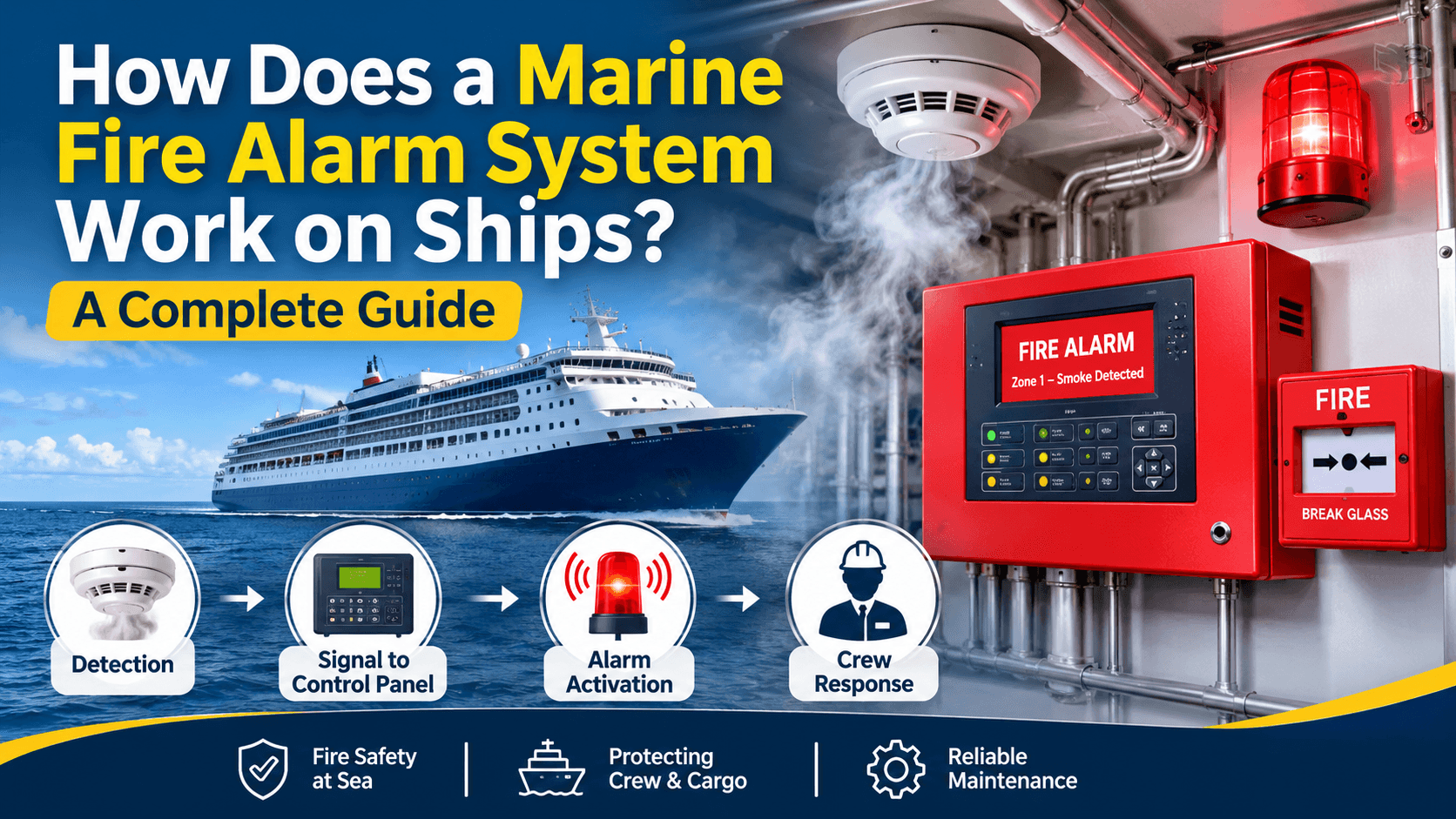
A marine fire detection system works by continuously monitoring protected spaces and transmitting signals from individual detection devices to a central fire alarm control panel.
The basic operating process involves the following steps:
1. Continuous Monitoring
Smoke, heat and flame detectors are installed in appropriate locations throughout the vessel. These devices continuously monitor their surrounding environment.
2. Fire Detection
When smoke particles, excessive heat or flame radiation reach the detector's operating threshold, the device identifies a potential fire condition.
3. Signal Transmission
The activated detector sends an electrical or digital signal to the fire alarm control panel through the connected detection circuit or communication loop.
4. Alarm Activation
The fire alarm control panel identifies the alarm condition and activates the appropriate audible and visual warning devices.
5. Fire Identification and Response
The crew checks the alarm location, follows onboard emergency procedures and takes the necessary action to control the situation.
6. System Monitoring
Modern addressable fire alarm systems can identify individual detectors and their locations, helping engineers and crew members investigate alarm conditions more efficiently.
Main Components of a Marine Fire Detection System
A complete marine fire alarm system consists of several interconnected components. Each component performs a specific function to ensure reliable fire monitoring and alarm notification.
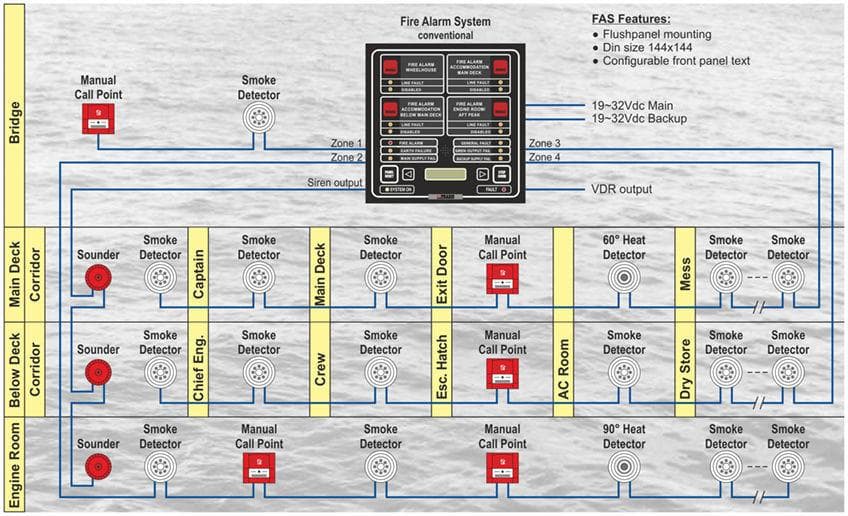
1. Fire Alarm Control Panel
The fire alarm control panel is the central processing unit of a fire detection system. It receives signals from detectors and manual call points, monitors system conditions and activates alarms when necessary.
Important functions include:
Monitoring connected fire detectors.
Identifying fire alarm conditions.
Displaying alarm locations and device information.
Detecting system faults and communication failures.
Activating audible and visual alarm devices.
Monitoring system power and backup power arrangements.
The selection of a marine fire alarm control panel depends on the vessel's detection requirements, system architecture and compatibility with the installed field devices.
2. Smoke Detectors
Smoke detectors identify smoke particles generated during the early stages of a fire.
Optical smoke detectors are commonly used in accommodation spaces, corridors, control rooms and other suitable areas.
They are particularly useful for detecting smouldering fires that may produce significant smoke before flames become visible.
3. Heat Detectors
Heat detectors respond to increases in temperature rather than smoke.
Depending on their design, they may operate when a specific temperature threshold is reached or when the temperature rises rapidly.
Heat detectors are useful in locations where dust, steam or normal operating conditions may cause unwanted smoke detector alarms.
Common applications include suitable machinery spaces, galleys and industrial environments.
4. Flame Detectors
Flame detectors identify radiation associated with flames. Depending on their technology, they may use ultraviolet (UV), infrared (IR) or combined sensing methods.
They are used in selected applications where rapid flame detection is important, including certain machinery areas, fuel handling locations and industrial installations.
The detector must be selected according to the potential fire type, environmental conditions and required detection coverage.
5. Manual Call Points
Manual call points allow crew members to manually activate the fire alarm when they discover a fire or another emergency requiring an alarm.
They are generally installed near exits, escape routes and other accessible locations according to the applicable design and regulatory requirements.
6. Detector Bases
Detector bases provide the mounting and electrical connection interface for compatible fire detectors.
They allow detectors to be installed, removed and replaced without unnecessarily disturbing the complete wiring arrangement.
Always verify the detector model, base type, electrical characteristics and system compatibility before ordering replacement components.
7. Alarm Sounders and Visual Indicators
Audible sounders and visual alarm indicators notify crew members when a fire alarm condition occurs.
These devices help ensure that warnings can be recognized in different areas of the vessel, including locations where machinery noise may make audible alarms difficult to hear.
8. Power Supply and Backup Batteries
Marine fire alarm systems require a reliable power supply to maintain continuous operation.
Depending on the applicable system design and regulations, the installation may include a main power supply and an emergency or standby power arrangement to maintain operation during loss of normal power.
Different Types of Fire Detectors Used on Ships
Selecting the correct fire detector is important because different detectors respond to different fire characteristics.
Detector TypeOperating PrincipleTypical ApplicationOptical Smoke DetectorDetects smoke particles using optical sensingCabins, corridors and control roomsIonisation Smoke DetectorDetects changes in ionisation caused by smokeSpecific approved applicationsFixed Temperature Heat DetectorActivates at a predetermined temperatureSuitable machinery and service spacesRate-of-Rise Heat DetectorResponds to a rapid temperature increaseSelected machinery and industrial spacesFlame DetectorDetects UV or IR radiation from flamesSelected fuel handling and industrial areasMulti-Sensor DetectorCombines multiple sensing technologiesApplications requiring enhanced detection
The appropriate detector depends on the protected space, expected fire characteristics, ventilation, environmental conditions and applicable approval requirements.
Marine Fire Detection Systems: Conventional vs Addressable
Marine fire alarm systems generally use different architectures depending on vessel size, installation requirements and system design.
Conventional Fire Alarm System
A conventional system divides the protected areas into detection zones.
When a detector activates, the control panel identifies the affected zone rather than necessarily identifying the exact detector.
Advantages:
Relatively straightforward system architecture.
Suitable for certain smaller installations.
Zone-based alarm identification.
Simple maintenance approach for compatible installations.
Addressable Fire Alarm System
An addressable fire alarm system identifies individual detectors and other connected devices through their assigned addresses.
When a device activates, the control panel can display its specific identification and programmed location.
Advantages:
Individual device identification.
More detailed alarm information.
Improved fault identification.
Easier identification of the affected area.
Better monitoring capabilities in appropriately designed systems.
For larger and more complex vessels, addressable systems can provide important operational advantages. However, the correct system must always be selected according to vessel requirements and applicable regulations.
Important Applications of Fire Detection Systems Onboard Ships
Marine fire detection systems protect different sections of a vessel because each area presents different fire risks.
Engine Room Fire Detection
Engine rooms contain fuel systems, lubricating oil equipment, electrical installations, generators and high-temperature machinery.
A suitable fire detection arrangement helps identify developing fire conditions in these critical areas.
Detector selection and placement must consider machinery operating temperatures, ventilation patterns and other environmental conditions.
Accommodation and Cabin Areas
Accommodation spaces contain furniture, electrical equipment, bedding and other combustible materials.
Smoke detection plays an important role in providing early warning to crew members and passengers.
Navigation Bridge and Control Rooms
Navigation bridges and control rooms contain important electronic equipment and communication systems.
Fire detection helps protect these spaces and supports the safe operation of the vessel.
Cargo Holds and Storage Areas
Cargo spaces may contain different types of materials with varying fire risks.
The detection arrangement depends on cargo characteristics, compartment design, accessibility and applicable regulatory requirements.
Electrical Rooms and Switchboard Compartments
Electrical faults, overheating connections and insulation failures can create fire hazards.
Appropriate detection equipment helps monitor these critical electrical spaces.
Offshore and Industrial Marine Installations
Offshore platforms, support vessels and specialised marine facilities may require fire detection solutions designed for demanding operating conditions, including hazardous areas where applicable.
Marine Fire Detection Regulations and SOLAS Requirements
Fire safety onboard ships is governed by international maritime regulations, national requirements and classification-society rules.
The International Convention for the Safety of Life at Sea (SOLAS), particularly Chapter II-2, addresses fire protection, fire detection and fire extinction.
SOLAS Regulation II-2/7 covers detection and alarm requirements. The IMO Fire Safety Systems (FSS) Code, particularly Chapter 9, provides technical requirements for fixed fire detection and fire alarm systems.
Important areas covered by the regulatory framework include:
Installation of approved fire detection and alarm systems where required.
Appropriate detector selection and positioning.
Manual call point arrangements.
Alarm indication and notification.
System testing and operational readiness.
Inspection and maintenance of installed equipment.
Requirements can vary according to vessel type, construction date, ship size, applicable SOLAS provisions, flag-state Administration and classification-society rules.
Ship owners and technical managers should consult the latest applicable regulatory requirements and approved vessel documentation before installing or modifying a fire detection system.
Common Marine Fire Detection System Problems
Even a properly designed fire detection system can experience operational problems if components deteriorate, wiring becomes damaged or maintenance is neglected.
Some common problems include:
1. False Fire Alarms
False alarms may result from dust, steam, contamination, unsuitable detector selection or environmental interference.
Recommended action: Inspect the affected detector, evaluate its operating environment and follow the manufacturer's cleaning and testing procedures.
2. Detector Communication Failure
Communication faults may occur due to damaged wiring, loose connections, faulty devices or problems with the detection circuit.
Recommended action: Check the relevant circuit, connections and device condition using the manufacturer's troubleshooting procedure.
3. Fire Panel Fault Indications
A fire alarm control panel may display fault conditions related to power supplies, batteries, communication circuits, detectors or other connected equipment.
Recommended action: Record the fault message and investigate the indicated circuit or component using the approved service documentation.
4. Detector Contamination
Smoke detectors can accumulate dust and other particles over time, potentially affecting their performance.
Recommended action: Inspect and clean detectors according to manufacturer instructions and the vessel's maintenance programme.
5. Backup Battery Problems
A deteriorated battery or faulty charging arrangement can affect the availability of the fire alarm system during loss of normal power.
Recommended action: Inspect the battery condition, charging system and required backup capacity.
6. Obsolete or Discontinued Components
Older vessels may use fire detection systems containing discontinued detectors, control modules, circuit boards and other electronic components.
Finding compatible replacement equipment can become challenging.
Recommended action: Record the manufacturer, complete model number, part number, photographs and system information before sourcing replacement equipment.
Marine Fire Detection System Maintenance Checklist
Regular inspection and maintenance are essential for keeping fire detection equipment operational.
Ship engineers and technical managers should maintain an appropriate inspection and testing programme based on manufacturer instructions, applicable regulations and the vessel's approved maintenance procedures.
A general maintenance checklist includes:
Inspect fire alarm control panels for active alarms and fault indications.
Check the condition of smoke, heat and flame detectors.
Inspect manual call points and their accessibility.
Verify the operation of audible and visual alarm devices.
Inspect detector bases and electrical connections.
Check system power supplies and standby batteries.
Review communication and circuit fault indications.
Test detectors using approved testing equipment.
Maintain records of inspections, testing and component replacement.
Investigate recurring faults and false alarms.
Ensure replacement components are approved and compatible.
Testing should be performed by qualified personnel using the appropriate equipment and procedures. Any temporary isolation of detectors or alarm circuits should follow the vessel's safety procedures, with the necessary compensatory fire safety measures in place.
How to Choose the Right Marine Fire Detection Equipment
Selecting suitable fire detection equipment requires careful consideration of the existing installation and the vessel's operating requirements.
Before purchasing a replacement detector, fire alarm panel or electronic module, consider the following factors:
1. Manufacturer and Brand
Identify the original manufacturer, such as Autronica, Consilium Salwico or Tyco, and check the equipment documentation.
2. Model and Part Number
Verify the complete model number and part number. Even small differences in product codes may indicate different specifications or compatibility.
3. System Compatibility
Confirm compatibility with the existing fire alarm control panel, detection loop, detector base and communication protocol.
4. Environmental Requirements
Consider temperature, humidity, vibration, dust and hazardous-area requirements where applicable.
5. Equipment Condition
Determine whether new, refurbished or used equipment is suitable for the application. Check its condition, documentation, testing history and required approvals.
6. Technical Documentation
Review datasheets, installation manuals, wiring information and manufacturer recommendations before installation.
Where to Source Marine Fire Detection Spare Parts?
Marine fire detection systems may contain specialised electronic components and detection devices that are difficult to source, particularly for older vessels.
Ship owners, ship managers, marine engineers and procurement departments often need reliable suppliers for replacement equipment to support maintenance and reduce unnecessary equipment downtime.
Fire Detection provides access to marine fire detection equipment and spare parts for customers looking for suitable solutions for their vessels and marine applications.
Whether you require smoke detectors, heat detectors, fire alarm panels, manual call points, detector bases or other fire detection components, identifying the correct manufacturer and model number is an important first step.
When making an enquiry, provide:
Product manufacturer and brand.
Complete model or part number.
Product description.
Required quantity.
Clear photographs of the existing equipment, if available.
This information helps the supplier identify the required component and assess its availability.
Looking for marine fire detection equipment or hard-to-find replacement parts?
Visit Fire Detection to explore available products or contact our team with your equipment requirements.
Frequently Asked Questions (FAQs)
1. What is a marine fire detection system?
A marine fire detection system is a safety installation designed to identify smoke, heat or flames onboard ships and vessels. It sends signals to a fire alarm control panel, which activates alarms to notify the crew.
2. Which types of fire detectors are used on ships?
Common types include optical smoke detectors, heat detectors, flame detectors and multi-sensor detectors. The appropriate type depends on the protected area and its fire risks.
3. What is the difference between a conventional and addressable fire alarm system?
A conventional system generally identifies the detection zone where an alarm originates, while an addressable system can identify individual connected devices and their programmed locations.
4. Are marine fire detection systems required under SOLAS?
SOLAS Chapter II-2 establishes fire detection and alarm requirements for applicable ships. The exact requirements depend on vessel type, construction date, protected spaces and applicable regulations.
5. How often should marine fire detection systems be tested?
Testing and inspection frequency should follow applicable regulations, manufacturer instructions, flag-state requirements and the vessel's approved maintenance programme.
6. Why does a marine smoke detector give false alarms?
Possible causes include dust, contamination, steam, unsuitable installation locations and environmental interference. The detector and surrounding conditions should be inspected to identify the cause.
7. Can obsolete marine fire alarm spare parts be replaced?
Yes, replacement may be possible depending on equipment availability, technical compatibility and manufacturer recommendations. The original model number, part number and system details should be checked before purchasing a replacement.
8. Which brands manufacture marine fire detection equipment?
Several manufacturers supply marine fire detection equipment, including Autronica, Consilium Salwico and Tyco. Equipment selection should consider the original installation and compatibility requirements.
9. What information is required when ordering marine fire detection spare parts?
Provide the manufacturer, complete model number, part number, product description, required quantity and photographs where possible. This information helps identify the correct equipment.
10. Where can I buy marine fire detection equipment?
You can explore marine fire detection products and spare parts through Fire Detection. Contact the team with your required model or part number to enquire about product availability.
Conclusion
Marine fire detection systems play a vital role in protecting ships, vessels, crew members, passengers and valuable onboard equipment. From smoke and heat detectors to flame detectors and advanced fire alarm control panels, every component contributes to identifying fire hazards and providing timely warnings.
Regular maintenance, correct detector selection, equipment compatibility and compliance with applicable maritime regulations are essential for reliable system performance.
For ship owners, marine engineers and technical procurement teams, sourcing the correct fire detection equipment is equally important, particularly when maintaining older systems or replacing discontinued components.
Need marine fire detection equipment or replacement spare parts?
Explore Fire Detection and send us your product requirements to enquire about suitable marine fire detection solutions.